


Most agencies treat non-English markets as a translation problem. Translate the ad, swap the landing page language, ship it. That’s why they fail.
Non-English paid acquisition isn’t about translation. It’s about localization, creative routing, and platform behaviour — three different problems, none of which “translate the ad” solves. We’ve proven this across multiple non-English markets.
Here’s one example: a Korean gambling campaign that pulled 603 leads at $4.98 CPL on $2,999.98 in spend.
CLIENT CONTEXT
The client operates in the online gambling space, targeting non-English-speaking audiences through Meta. In this case, the market was South Korea — a restricted vertical in a non-English geo with different cultural trust signals, platform behaviour, and compliance dynamics. Most agencies won’t even take the brief.

THE PROBLEM
Non-English markets fail for three reasons — and none of them are about language.
Cultural context doesn’t translate. Humour, urgency cues, social proof, trust markers — all shift by region. What builds credibility in English-speaking markets can feel foreign or hollow in another language. A translated ad isn’t a localized ad. It’s an English ad wearing a costume. This applies whether you’re running in Korean, German, Portuguese, or any other non-English market.
Platform behaviour differs by geo. What Meta surfaces, what gets flagged, how audiences interact with content — all change depending on the market. Audience segments that perform in English campaigns don’t map cleanly to non-English-speaking users. The algorithm needs different signals in every region.
Restricted niches compound the difficulty. Gambling already gets throttled in English markets. Add a non-English audience layer and most agencies bail. The compliance challenges multiply, the creative constraints tighten, and the margin for error shrinks. Most agencies don’t have the infrastructure to operate in non-English restricted verticals — so they don’t.
If you’ve tried running paid ads in non-English markets and blamed the platform or the niche, the real problem was probably the approach.

ZP’S APPROACH
We don’t translate campaigns. We rebuild them for the market. This applies to every non-English geo we run in — Korea is one example of the same principle.
The creative process starts with cultural context, not copy. Before writing a single line, we map how the target audience responds to social proof, what urgency looks like in their market, and which trust signals actually move behaviour. Non-English audiences don’t respond to the same hooks as English-speaking ones. The creative has to feel native — not translated.
Audience signals are built from the ground up. We don’t port English-market targeting into a new geo and hope for the best. Platform behaviour shifts by region — what Meta surfaces, how users engage, which signals the algorithm rewards. We build audience clusters specific to the market and let cost-per-lead data guide which ones scale.
Platform routing is treated as its own discipline. Which placements perform, how the algorithm behaves in each geo, what gets flagged in restricted verticals — all handled as separate problems from the creative itself. The campaign structure is designed for the platform behaviour in the specific market, not adapted from an English template.
The principle is simple: every layer of the campaign — creative, targeting, platform mechanics — is built for the market it runs in. Not translated into it.
PERFORMANCE DASHBOARD
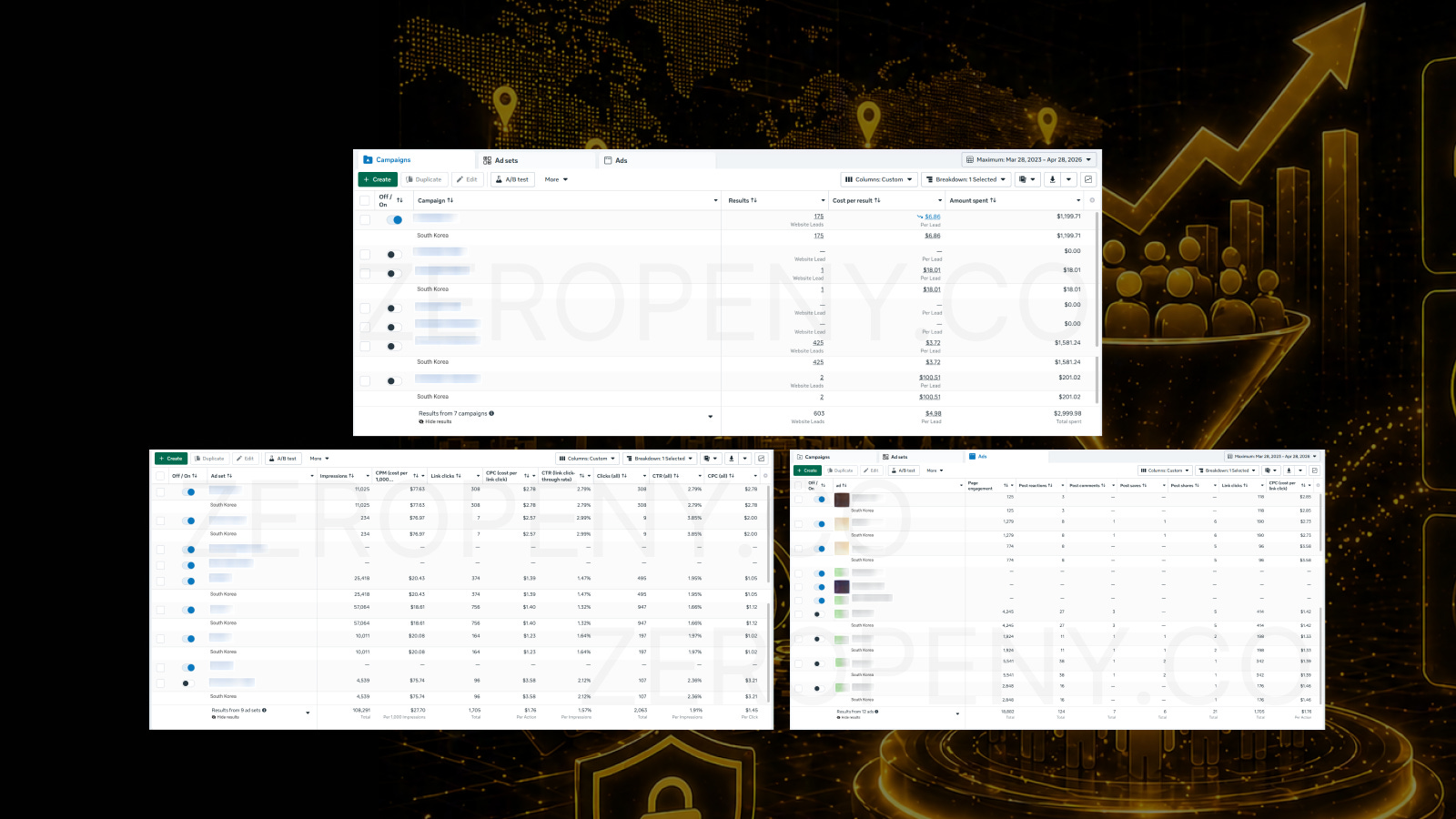
RESULTS
Leads: 603.
Cost Per Lead: $4.98.
Amount Spent: $2,999.98.
CTR: 1.57%.
603 leads at $4.98 each in a restricted vertical, in a non-English market, on Meta. These aren’t numbers you get by translating an English campaign. They’re numbers you get by building one that belongs in the market.
THE TAKEAWAY
Non-English markets aren’t harder because of the language. They’re harder because most agencies only solve for language and ignore everything else — cultural context, platform behaviour, audience signals, compliance dynamics. Translation is step one. It’s not the strategy.
This Korean campaign is one proof point of a broader principle: when every layer is built for the market, results follow. 603 leads, $4.98 CPL, $2,999.98 spent. Restricted vertical. Non-English audience. Meta.
If you’ve been told your market is “too niche” or “too difficult” for paid acquisition — in any language — the problem wasn’t the market. It was the approach. And if you’re still translating English campaigns and wondering why they underperform, now you know why.
📩 1-tap message us:
Disclaimer: These results reflect individual case studies, not guaranteed outcomes. Performance depends on multiple variables including strategy, spend, funnel quality, and niche dynamics.